Boost Conversions: Video Testimonials vs Reviews for Shopify Stores

Prioritize written reviews for discovery and early-funnel scanning, and lean on video testimonials once a shopper has narrowed their options and needs reassurance. Text builds volume and searchable trust signals; video builds the emotional confidence that closes high-consideration purchases. If you run one test this quarter, try adding a short video testimonial below the fold on your top three product pages and measure conversion against the text-only control.
TL;DR:
- Video testimonials significantly increase trust and conversion rates when they show product use and address specific doubts such as fit or durability.
- Written reviews gather in higher volume and remain essential for search engine visibility, especially for early-funnel shoppers seeking quick, scannable information.
- Collecting high-quality video reviews requires a deliberate workflow, including timing prompts post-purchase, reducing friction, and ensuring moderation and accessibility.
- Combining text, video, and reviews on hybrid product pages maximizes trust signals by providing quick ratings, emotional proof, and detailed insights.
- Using tools like Peers simplifies embedding and managing video reviews on Shopify, enabling small-scale testing of hybrid formats with minimal cost.
Table of Contents
- Testimonials, reviews, and video reviews defined
- Why video testimonials build trust and drive conversions
- Why written reviews still carry the store
- The tradeoffs that actually affect your conversion rate
- Where and when each format earns its place on the page
- How to collect, moderate, and scale video testimonials
- The case for hybrid pages over picking one format
- How Peers helps Shopify stores embed video reviews and Q&A
- Sources
- FAQ
Testimonials, reviews, and video reviews defined
The terms get used interchangeably, but they describe different things. A review is typically a rating plus a short comment, often unsolicited and collected at scale through a post-purchase flow. A testimonial is a curated endorsement, usually requested from a specific customer, and framed to highlight a particular benefit or outcome. Reviews aim for volume and honesty; testimonials aim for persuasion and specificity. In practice, many e-commerce brands blur the line by calling curated video reviews “testimonials” regardless of how they were sourced.
A video testimonial (sometimes called a video review) is a recorded clip, typically 15 to 90 seconds, where a customer speaks about their experience with a product, often while showing it in use. A video review can be shorter and more casual, closer to an unboxing or first impression than a structured endorsement.
Common distribution channels include:
- On-site placement: product detail pages, dedicated review sections, and homepage carousels.
- Post-purchase email: requests sent days after delivery, often with a direct upload link.
- Social channels: repurposed clips on Instagram, TikTok, or YouTube Shorts.
- Paid ads: testimonial clips used as creative in retargeting campaigns.
Most brands collect once and distribute across all four, which is where a structured capture workflow starts to matter more than the format itself.
Why video testimonials build trust and drive conversions
Video carries information text cannot: facial expression, tone of voice, hesitation, and enthusiasm. Shoppers read those cues as harder to fake than written praise, which is why a video testimonial often feels more credible than a five-star comment, even when the underlying sentiment is the same. Watching someone use a product in real conditions also answers questions a spec sheet cannot, like how a fabric drapes or how loud an appliance runs, cutting down the uncertainty that stalls a purchase decision.
The data backs this up. A 2025 study analyzing an e-commerce seller dataset found that reviews containing images and video achieved higher conversion rates and greater revenue compared with text-only reviews, using statistical tests across the sales data. Separately, Statista’s tracking of shopper behavior shows a large share of buyers consult reviews before purchasing, with many preferring video over text or static photos when researching a product.
Video testimonials work best when they show product usage and address specific doubts, like fit, return policy, or long-term durability, rather than offering generic praise. That specificity is what separates a persuasive clip from a forgettable one.
Video is not free, though. Production and moderation take time, capture friction discourages busy customers from recording anything at all, and accessibility requirements mean every clip needs captions or a transcript to reach shoppers who cannot or prefer not to use audio. None of this rules video out. It just means the format needs a deliberate workflow rather than a hope that customers will film something usable on their own.
- Emotional cues like tone and facial expression increase perceived authenticity beyond what text can convey.
- Product-in-use footage reduces uncertainty on fit, sound, texture, and other details specs cannot capture.
- Multimedia reviews correlate with higher conversion and revenue in controlled dataset analysis.
- Friction and cost remain real constraints: recording, moderating, and captioning all take resources.
Why written reviews still carry the store
Text reviews scale in a way video never will. A customer can leave a star rating and a two-sentence comment in under a minute, which is why written reviews accumulate into the hundreds or thousands while video testimonials stay in the dozens for most stores. That volume matters because aggregated star ratings and review counts are the first trust signal a shopper sees, often before they read a single word.
Text also carries structural advantages video cannot match. Written reviews are indexable, which means search engines can surface review snippets and structured data (star ratings, review counts) directly in search results. That visibility drives organic traffic that a video, locked inside a page or a social post, generally cannot generate on its own.
For early-funnel visitors who are still comparing options, scannability matters more than depth. A shopper skimming ten product pages in five minutes needs a rating and a highlighted phrase, not a 45-second clip they have to sit through. Written excerpts reduce that cognitive load, letting shoppers filter fast and decide which products deserve a closer look.
- Low collection friction means text reviews accumulate faster and in higher volume than video.
- Searchability lets review content and star ratings appear in organic search results.
- Scannability helps early-stage visitors filter options quickly without watching anything.
- Excerpted quotes from written reviews can headline a video section, avoiding duplicate content while reinforcing the same point in two formats.
The two formats are not competitors so much as different tools for different moments. Pairing them, rather than picking one, is where most of the practical guidance in this article points.
The tradeoffs that actually affect your conversion rate
The real decision is not “video or text.” It is about which axis matters most for a given page or campaign, since video and text trade strength for scale on nearly every dimension that matters to a marketing team.
Video wins on depth. A single well-made clip can carry more persuasive weight than a dozen written comments, because it demonstrates rather than describes. Text wins on breadth. You can collect hundreds of written reviews for every video testimonial you manage to capture, which means text does the heavy lifting for aggregate trust signals while video handles the moments that need extra conviction.
Collection friction runs in the opposite direction from persuasive power. Written reviews need only a form and a rating scale, so ask rates stay high with minimal incentive. Video needs a working camera, decent lighting, and a customer willing to be on record, so ask rates drop and moderation overhead rises, since every clip needs a human review before it goes live.
SEO tips the balance toward text. Search engines index written content and structured review markup, and that indexable text is part of why written reviews remain central to product page SEO even as video grows in popularity elsewhere. Video content can drive reach on platforms like YouTube or TikTok, and Statista’s ranking of video content types by global reach places review and demo formats among the most-watched categories worldwide, but that reach rarely translates into the same on-page search visibility that a block of indexed text delivers.
Timing changes the effectiveness of the same clip. Phys found that displaying short video reviews later in a buyer’s decision process, after they have already narrowed their options, boosts confidence and conversion more than showing the same video during early discovery. The clip does not change. Its position in the funnel does.
On measurement, track view-through rate on video (how many shoppers who load a page actually watch), time-to-cart after a video view, and conversion lift on pages with video versus a text-only control. A drop in support tickets or return requests after adding video is also worth tracking, since it often signals the clip answered a question that used to require a message to your team.
Compliance and accessibility are not optional extras. Every video testimonial should carry captions and, ideally, a text transcript, both for shoppers who cannot use audio and for search engines that cannot watch video. Disclosure matters too: if a testimonial was incentivized, say so, in plain language, near the clip.
- Depth versus breadth: video persuades deeply per view; text scales trust across many more shoppers.
- Friction versus reach: text has low collection friction; video requires more effort from both customer and moderator.
- SEO advantage: indexable text and structured data support organic visibility that video cannot replicate on-page.
- Accessibility requirement: captions and transcripts are necessary, not optional, for any video testimonial.
Where and when each format earns its place on the page
Placement and timing matter as much as the format itself. A checklist helps translate the tradeoffs above into decisions you can actually make on a product page.
- PDP hero section: keep this text-first, a star rating and review count, since shoppers arriving here are often still deciding whether to stay on the page at all.
- Reviews column or tab: mix format here, leading with aggregated ratings and written excerpts, then surfacing video testimonials for shoppers who scroll deeper.
- Gallery or “see it in action” module: this is prime video real estate, especially for products where fit, sound, or texture is hard to describe in text.
- Post-purchase and retargeting messaging: video testimonials work well here because the shopper has already shown intent and is looking for a final nudge.
- Paid ad creative: short video clips, 15 to 30 seconds, tend to outperform static testimonial graphics for high-consideration products.
On timing, the research is specific: show ratings and short excerpts early, since that is what a discovery-stage shopper scans for, and hold video for later in the page or later in the funnel, once options have narrowed and the shopper needs reassurance rather than information. This matches the placement finding above: the same clip converts better after the decision has been narrowed than during initial discovery.
Product type matters too. Experience goods (skincare, apparel, food), demo-dependent products (electronics, tools, fitness equipment), and high-consideration purchases (furniture, appliances, anything over a threshold price point that triggers more research) tend to benefit most from video. Commodity items with well-understood specs, like batteries or office supplies, rarely need it.
For testing, run a simple A/B split: control gets text-only reviews, variant adds one video testimonial per product page. Give the test at least two to four weeks to account for weekly buying patterns, and aim for enough traffic per variant that a conversion difference of a few percentage points would be statistically distinguishable from noise, not just a lucky week.
How to collect, moderate, and scale video testimonials
Most stores that try video testimonials once and give up made the same mistake: they asked too late, made recording hard, and had no plan for moderation. A repeatable workflow fixes all three.
- Trigger the ask at the right moment. Post-purchase, once the product has arrived and a customer has had a few days to use it, works better than asking at checkout. For products with a learning curve, a second ask at a usage milestone (first workout logged, first week of use) often produces better footage than a single request.
- Remove capture friction. Asynchronous mobile capture, where a customer records directly in their browser or a linked app rather than uploading a separate file, meaningfully raises submission rates. Bazaarvoice’s rollout of direct video uploads reports that removing upload friction increases the volume of authentic on-site video reviews, since customers are far more likely to record thirty seconds on their phone than to edit and export a file first.
- Build consent into the flow. Ask for permission to use the clip on-site, in ads, and on social in the same step as the recording request, not after the fact.
- Moderate before publishing. Every clip needs a human check for content and quality, plus captions, a transcript, and metadata tags (product SKU, star rating, purchase date) so the clip can be surfaced contextually on the right page.
- Scale with short scripts, not incentives alone. A simple three-question prompt (What problem did this solve? What surprised you? Who would you recommend it to?) produces more usable footage than an open-ended request, and it reduces editing work later.
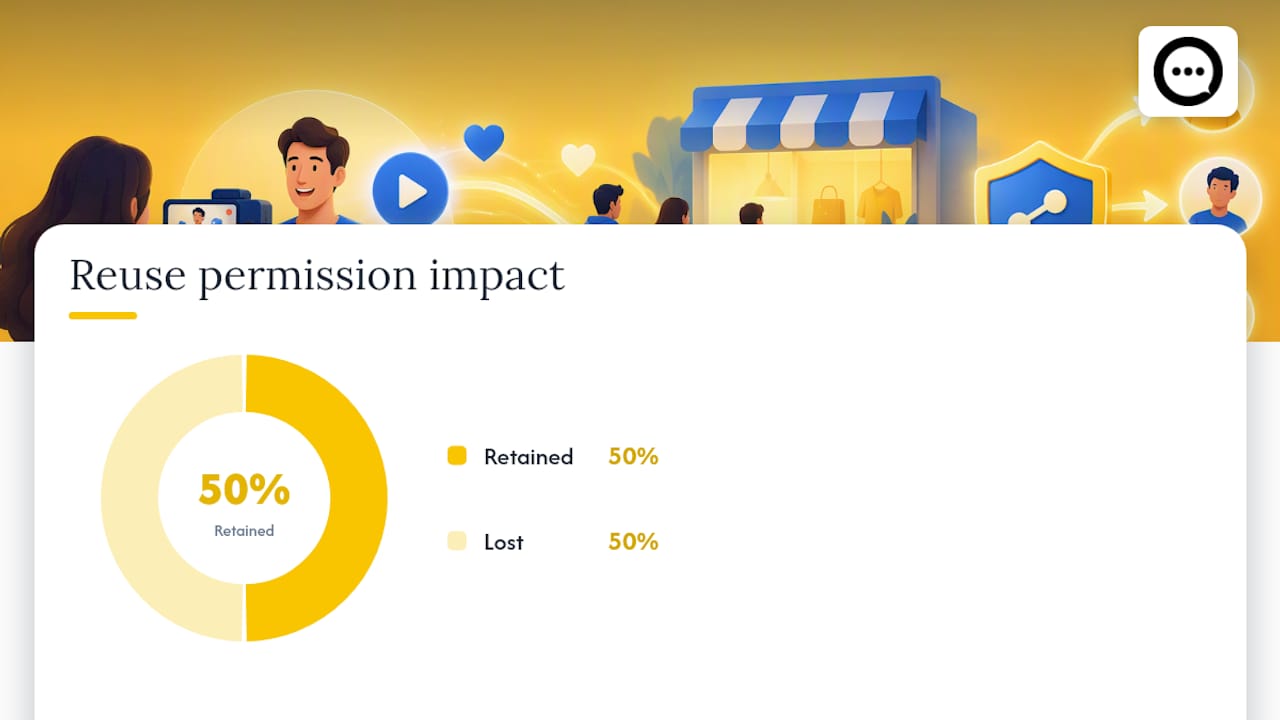
Pro Tip: Ask for permission to reuse a customer’s clip across email, ads, and social in the same request where you ask them to record it. Going back later for reuse rights cuts your usable footage in half.
To set a baseline, run the same experiment described earlier and track view-through rate, time-to-cart, and conversion lift over four weeks. If you want this handled without building capture, moderation, and hosting yourself, Peers is a Shopify-native widget built specifically for post-purchase video review collection, including consent and moderation steps baked into the flow.
The case for hybrid pages over picking one format
The honest answer is that “video versus text” is the wrong frame. A 2024 study of 8,693 reviews found text helpfulness follows an inverted U-shape, useful up to a point, then a drag once it gets too long, while video helpfulness climbs only after it clears a minimum duration. That is not a case for either format. It is a case for combining them deliberately: a star rating for the scan, a short video clip for the emotional proof, and a written excerpt underneath for the shopper who wants detail without pressing play. One line of layout: rating first, clip second, excerpt third, in that order, every time.
— Leo
How Peers helps Shopify stores embed video reviews and Q&A
If you sell on Shopify and want the hybrid layout above without building capture, moderation, and hosting from scratch, Peers is built specifically for that job. It embeds post-purchase video reviews and shopper Q&A directly on product pages, with moderation tools and mobile-first capture so customers can record without downloading anything extra.
This type of tool fits stores that already collect written reviews and want to add verified video without a separate platform to manage. It is not a general review tool but typically designed to work best for merchants on a particular e-commerce platform rather than stores running other software.
- Post-purchase video capture with consent and moderation built into the request flow.
- Shopper Q&A that lets prospective buyers ask verified customers questions directly on the page.
- Mobile-first recording that removes the upload friction covered earlier in this article.
Start small: install Peers, test it on one product or category, and compare conversion against your text-only pages. Plans include a Free tier and Peers Growth at $15 per month, so testing the hybrid approach on a handful of products costs little to try.
For layout inspiration once you have footage flowing, this social proof placement guide covers practical ways to position testimonials for maximum visibility.
Sources
- Comparative analysis of review formats and sales impact (conference paper)
- Hybrid review elements and perceived helpfulness (MDPI)
- Phys
- Local online business review usage (Statista)
FAQ
What is the difference between testimonials and reviews?
A review is typically an unsolicited rating and comment collected at scale after purchase, while a testimonial is a curated endorsement requested from a specific customer to highlight a particular benefit. In practice, many brands use the terms interchangeably, especially for video content.
What is a video testimonial?
A video testimonial is a short recorded clip, usually 15 to 90 seconds, where a customer describes their experience with a product, often while showing it in use. It carries tone, expression, and context that written reviews cannot convey.
What are the different types of testimonials?
Common types include written text testimonials, video testimonials, audio clips, and case-study style long-form testimonials. Video testimonials are increasingly favored because shoppers report preferring video over text or static photos when researching products.
Can you give me examples of video testimonials?
Typical formats include unboxing-style first impressions, “how I use this” demonstration clips, and short direct-to-camera endorsements answering a specific doubt like fit or durability. The most effective ones show the product in use rather than offering generic praise, per research on multimedia review conversion.
Should I prioritize video or written reviews first?
Start with written reviews since they scale faster and support the star ratings and SEO signals that drive early discovery. Add video testimonials once you have traffic to test them, placing clips later in the funnel where research shows they convert best.