5 Step Video Testimonial Consent Checklist for Shopify Merchants

Before you publish a customer video testimonial, get a dated, signed release that explicitly covers moving image and audio, names the channels you will use, permits editing, states attribution, territory and term, and discloses any incentive you paid. Keep that signed record filed with the video itself, and run an advertising and FTC check before the testimonial ever reaches a paid placement.
TL;DR:
- Using customer video testimonials requires signed releases that specify rights, channels, editing permissions, attribution, territory, and duration to ensure legal compliance.
- Video testimonials pose more risks than text quotes due to rights over the customer’s face, voice, and mannerisms, which are governed by publicity, privacy, advertising, and data laws.
- A clear separation between consent (data collection permission) and release (rights to publish and distribute) is crucial, especially when publishing videos online or sharing with third parties.
- An effective consent/release form must include participant identification, rights granted, distribution channels, purpose, withdrawal process, disclosure of incentives, and parental consent for minors.
- Running a workflow that verifies identity, attaches signed records to videos, and tracks distribution channels helps prevent legal issues and maintains authenticity.
Table of Contents
- Why video testimonials are legally riskier than text quotes
- Consent vs release: what each grants and when you need both
- Core elements every video testimonial consent/release form should include
- Example: short annotated template language to adapt
- Pre-publish checklist: operational steps to confirm consent and prepare the asset
- Practical workflow for Shopify merchants: capture, store, moderate, and embed with consent
- Why consent as a workflow preserves authenticity and reduces legal risk
- How Peers helps Shopify merchants collect, manage, and embed video testimonials with consent records
- FAQ
- Sources
Why video testimonials are legally riskier than text quotes
A text quote is words on a page. A video testimonial carries someone’s face, voice, mannerisms and unscripted phrasing, which pulls in a different set of legal exposures than a written review ever triggers. Right-of-publicity and privacy laws govern the commercial use of a person’s name, likeness and voice, and those rights exist independently of whether the person liked your product. A customer can hand you glowing feedback and still object, later, to seeing their face in a paid ad campaign they never agreed to.
Advertising law adds a second layer. The FTC’s Endorsement Guides require that an endorsement reflect the honest opinion of the person giving it and that any material connection, such as a discount, free product or payment, be disclosed clearly and conspicuously. If you gave a customer a gift card in exchange for their testimonial, that relationship has to be visible to the viewer, not buried in fine print.
Data protection law adds a third. Under the UK GDPR, businesses must be able to demonstrate when and how consent was obtained and must offer a withdrawal method that is as easy to use as the original consent, according to ICO guidance on lawful basis. A verbal “sure, go ahead” on camera is not a record you can produce later if a customer asks you to take the video down.
These three concerns intersect but don’t substitute for each other:
- Privacy and publicity law protects the person’s identity and image from unauthorized commercial use.
- Advertising law protects viewers from deceptive or undisclosed promotional content.
- Data protection law protects the customer’s control over their own personal data, including the right to withdraw.
A signed release is evidence that consent happened, not proof that your advertising is honest. The FTC’s 2023 Endorsement Guides make that separation explicit: a release gives you permission to publish, but the testimonial still has to be truthful and non-misleading on its own terms. You need both pieces working together, not one standing in for the other.
Consent vs release: what each grants and when you need both
Marketers often use “consent” and “release” interchangeably, but they answer different legal questions and usually come from different bodies of law.
Consent is permission to collect and process someone’s personal data, including their recorded image and voice. It is the basis you rely on under data protection frameworks like the UK GDPR, and it has to be informed, specific and freely given. Consent also covers the act of recording itself: did the person know they were being filmed, and did they agree to it?

Release is a contractual grant of rights that lets you publish, reproduce, edit and distribute the recording commercially. It deals with intellectual property and publicity rights rather than data protection, and it is what actually authorizes you to put the video in an ad, on your website or on a retail partner’s page.
You typically need both when:
- You plan to publish the video online, in ads, or hand it to a retail or affiliate partner.
- The testimonial involves a minor, which adds a parental consent layer on top of the release.
- You compensated the customer in any way, which triggers the FTC’s disclosure requirement regardless of what the release says.
- A third party, such as a media buyer or syndication partner, will also distribute the asset.
Good intake practice separates these explicitly. Rather than one vague “I agree to the terms” checkbox, use distinct, named checkboxes: one for consenting to be recorded, one for granting publication rights, one for permitting edits, and one acknowledging any payment or discount received. Washington University’s guidance on consent forms for photos, video, audio and testimonials treats these as separate permissions rather than one blanket grant, which is the right instinct for commercial use too.
Core elements every video testimonial consent/release form should include
A usable form has to do double duty: protect you legally and stay short enough that a real customer will actually fill it out. Based on institutional release practice and FTC disclosure requirements, here’s what belongs in the document.
- Participant identification and age confirmation. Full legal name, date of birth or a signed statement confirming the person is an adult, and contact information for follow-up or withdrawal requests.
- Explicit grant of rights. A clause permitting you to publish, reproduce, edit, excerpt, translate and sublicense the video and audio, not just “use” it in vague terms.
- Permitted channels and third parties. Name the platforms (your website, social media, paid ads, retail partner pages) where the testimonial may appear, and whether you can hand it to distribution partners.
- Purpose, territory and term. State why you’re collecting the testimonial, where in the world it may be shown, and for how long the grant lasts, whether that’s a fixed period or until revoked.
- A working withdrawal process. Explain how the customer can ask you to stop using the video and what happens to placements that are already live.
- Attribution preferences. Does the customer want their full name shown, first name only, or to remain anonymous with just a photo or voice?
- Compensation and material-connection disclosure. Document any discount, gift card or payment given in exchange for the testimonial, matching FTC disclosure expectations.
- Honest-opinion confirmation. A short statement that the testimonial reflects the customer’s genuine experience and views, which supports your FTC compliance position if questioned later.
- Privacy notice reference. A link or reference to your privacy policy explaining how the recorded data will be stored and used.
- Retention period. How long you intend to keep the raw footage and the signed form on file.
- Electronic signature compliance. Use a signature method that satisfies ESIGN and UETA standards for enforceability, capturing clear intent and a retrievable record.
- Parental or guardian consent for minors. A separate signature block completed by a parent or legal guardian whenever the subject is under 18.
The UMass Global testimonial release form template is a useful reference point: it bundles a warranty of age, a broad grant for marketing use, and a waiver of further compensation into a single, short document, which shows how compact a legally solid form can be. Jotform’s testimonial consent template follows a similar structure, with checkbox fields that make each grant of rights explicit rather than buried in paragraph text.
Pro Tip: Build your consent form as a short set of yes/no checkboxes rather than one dense paragraph. Customers skim, and separated checkboxes make it obvious exactly what they agreed to if a dispute ever comes up.
Example: short annotated template language to adapt
You don’t need a lawyer-length document to cover the essentials. Below is sample clause language you can adapt, with notes on why each piece exists.
Grant of rights clause:
This clause exists because a release that only says “use my testimonial” leaves ambiguity about whether editing or third-party distribution is allowed, and ambiguity is exactly what gets challenged later.
Editing and excerpt clause:
The limiting phrase matters. The FTC’s Federal Register examples flag misleading imagery and atypical result framing as a real enforcement concern, so your edit permission should never give you license to cut a testimonial in a way that changes its meaning.
Material-connection disclosure checkbox:
- “I received [discount/free product/payment] in exchange for providing this testimonial.” (Yes/No, with space to specify the incentive.)
- “I did not receive any compensation for this testimonial.” (Yes/No)
Attribution choice:
- First name and last initial only
- Full name
- Anonymous with photo/voice only
For testimonials from minors or anything touching health or financial claims, add a parental signature block and route the content through counsel before publication. Regulated categories carry disclosure and substantiation rules well beyond a standard release, and a generic template will not cover you there.
Pre-publish checklist: operational steps to confirm consent and prepare the asset
A signed form that sits in a folder nobody checks is not a compliance program. Run through this sequence before any testimonial goes live or into paid media.
- Verify identity and scope. Confirm the signer is the person in the video and that the signed release actually covers the use you’re about to make, whether that’s a product page, an email campaign or a paid ad.
- Attach the signature record to the asset. File the dated, signed consent directly with the video file, not in a separate system that can drift out of sync.
- Run the advertising check. Confirm the honest-opinion language is present and that any incentive disclosure is placed where a viewer will actually see it, not in a footnote.
- Apply consistent file naming and storage. Use a naming convention that ties the video to its consent record, set a retention schedule, and maintain a suppression list for any customer who later withdraws.
- Confirm third-party coverage. Before handing the asset to an ad network or retail partner, double-check the release actually permits that specific kind of distribution.
Pro Tip: Keep a single spreadsheet or database row per testimonial that links the video file, the signed consent, the date, and every channel where it currently lives. When a withdrawal request comes in, that one row tells you everywhere you need to pull it.
The ICO’s guidance on consent is direct about this operational piece: withdrawal has to be genuinely as easy as giving consent, which means your team needs to be able to locate the record, map where the asset is live, and act on a request without a weeklong internal search.
Practical workflow for Shopify merchants: capture, store, moderate, and embed with consent
For a Shopify store collecting video testimonials at scale, the workflow has to be built into the post-purchase moment rather than handled as a one-off legal exercise.
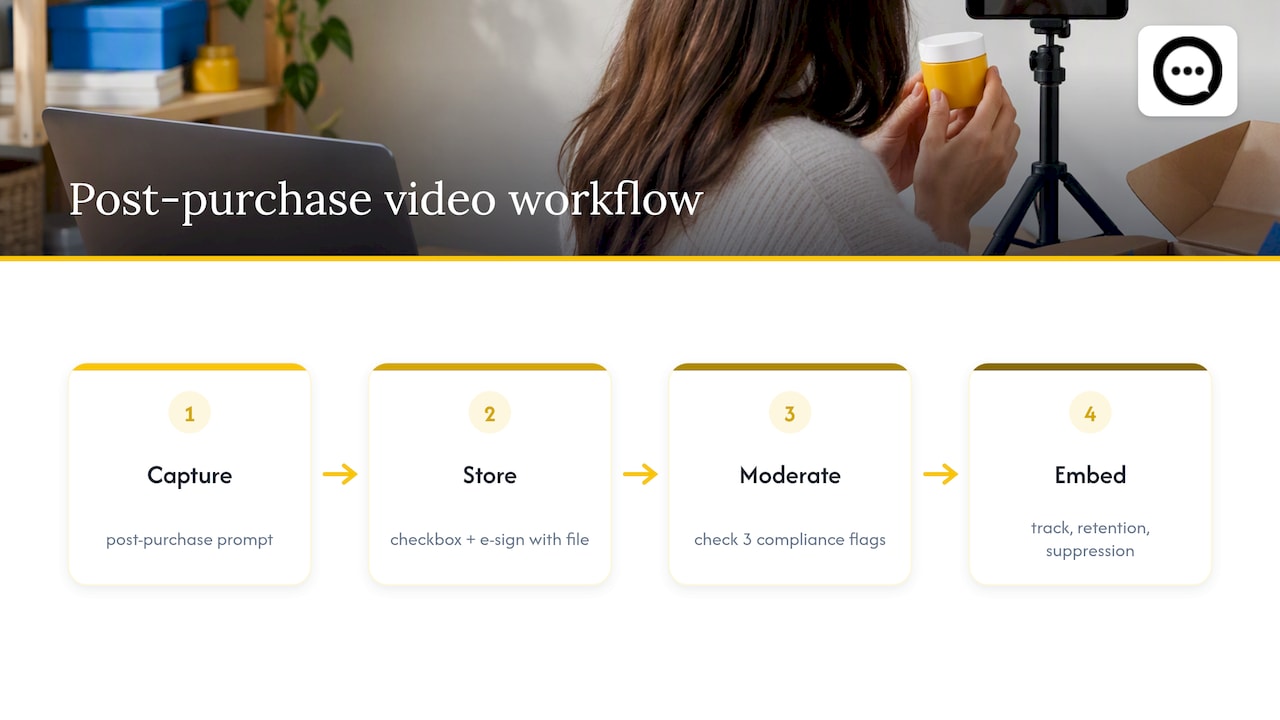
Capture starts right after a purchase, when a shopper is prompted to record a short video review. The intake screen should carry explicit consent checkboxes, not a buried terms link, and an electronic signature that gets stored together with the video file rather than in a separate system.
Moderation comes next. Before any testimonial goes live on a product page, someone should check three flags: did the customer consent to the specific use intended, is any incentive disclosed if one was given, and does the content avoid misleading claims about results. This is also where a reviewer catches a testimonial that technically has consent but makes an unsubstantiated claim that shouldn’t go near an ad.
Embedding and governance tie it together. Track exactly which product pages and channels carry each video, set a retention period for the footage and its consent record, and keep a suppression list so a withdrawal request can be honored everywhere the video currently lives, not just on the page where someone happened to notice it.
This sequence addresses both legal fronts at once: the signed, stored consent protects against privacy and publicity claims, and the moderation step protects against advertising compliance problems before a testimonial ever reaches a shopper. Peers builds post-purchase video capture and moderation for Shopify stores around this kind of structure, which is worth knowing if you’re setting this up in-house and want a reference point for how the pieces fit together.
Why consent as a workflow preserves authenticity and reduces legal risk
A signed form is a snapshot. A workflow is what actually protects you, because consent that lives only on paper in a drawer does nothing when a customer asks you six months later where their video is being shown.
The real tension in this work is between editability and authenticity. Trim a testimonial too aggressively and you risk misrepresenting what the customer actually said, which is exactly the scenario the FTC’s examples warn about. Leave it untouched and you may end up with something unusable for a thirty-second ad. Disclosure is what lets you resolve that tension honestly: a clearly labeled incentive or a visible “edited for length” note protects your credibility far more than a technically compliant but opaque testimonial ever will.
Treat this as a shared responsibility between legal, product and marketing rather than a form your sales team collects once and forgets. The businesses that get burned are rarely the ones without a release on file. They’re the ones who had one and never built a system to honor what it actually said.
— Leo
How Peers helps Shopify merchants collect, manage, and embed video testimonials with consent records
We provide a tool designed for Shopify stores that want authentic post-purchase video reviews and shopper Q&A on their product pages without stitching together separate tools for capture, moderation and consent tracking. The post-purchase prompt captures the video and the shopper’s consent together, moderation tools let you check disclosure and editorial flags before anything goes live, and embedding setup keeps the video tied to its record on the product page where it belongs.
This matters most when you’re trying to move fast without cutting corners on compliance: you get the review, the consent, and the publishing all handled in one place instead of juggling a signature tool, a video host and a social media management tool separately.
- A free plan lets you start collecting post-purchase video reviews and shopper Q&A.
- A growth plan adds moderation and embedding features that many growing stores need.
If you want to see how this fits your store, visit our Shopify app listing and try the free plan to test the post-purchase capture and consent workflow for yourself.
FAQ
What is a testimonial video example?
A testimonial video example is a short recording where a real customer describes their experience with a product or service in their own words, often prompted by a question like “what problem did this solve for you.” Businesses typically collect these post-purchase and use them on product pages, in ads or on social media once proper consent is documented.
What is required for video consent?
At minimum, you need a dated, signed release that explicitly covers the recorded image and voice, names the channels where the video will appear, states whether editing is permitted, and discloses any compensation given in exchange for the testimonial. Institutional release templates also recommend including territory, duration and a withdrawal process as standard fields.
Are fake testimonials illegal?
Fabricated or deceptively edited testimonials violate the FTC’s Endorsement Guides, which require that endorsements reflect honest opinions and that any material connection be disclosed. A business using a fake or misrepresented testimonial in advertising risks FTC enforcement regardless of whether a release was signed.
What is a video testimonial?
A video testimonial is a recorded statement from a customer sharing their genuine opinion or experience with a product, used by businesses as social proof in marketing. Unlike a written review, it captures a real person’s face and voice, which is why it requires both data-protection consent and a publicity or IP release before commercial use.
Sources
- FTC: Guides Concerning the Use of Endorsements and Testimonials in Advertising (16 C.F.R. Part 255)
- Washington University: Consent forms for photos, video, audio, testimonials
- ICO: A guide to lawful basis — consent
- UMass Global: Photo/Video/Audio/Testimonial Consent Form (template)
- Federal Register: Final rule text and examples for the FTC Endorsement Guides (2023)