Shopify UGC Rights: What to Secure Before You Reuse Customer Content

Your customer owns the photo, video or review they made, and you need their permission to use it on your Shopify store. In most cases a written, non-exclusive license is enough. You do not need to take ownership of anything. What you do need is a clear request, a record of the answer and honest handling of any reward you offered. This guide shows how to get there.
TL;DR
- Customers generally keep the copyright in what they create. A public post or a tag is not a blanket license for your store.
- A non-exclusive license, in writing, covers most store uses: product pages, email, social and ads.
- Forcing customers to hand over ownership of review content can make your terms void in the US. Ask for the narrow license instead.
- If you give a discount, free product or payment for content, disclose it, and never tie the reward to positive sentiment.
- When someone’s face or voice appears, get written consent. If they withdraw it, take the content down and keep the record.
Table of Contents
- Who owns customer-generated content
- Why a non-exclusive license is the right ask
- What a UGC permission should spell out
- Incentives and the FTC: disclose them, never buy praise
- Social posts and tags are not automatic permission
- When a person appears in the content
- A simple permission workflow for a Shopify store
- Handling withdrawals, takedowns and other countries
- Our perspective on rights and trust
- Collect consented video reviews and Q&A on Shopify
- FAQ
- Sources
Who owns customer-generated content
The short answer: the person who made it. The U.S. Copyright Office explains that users generally own the copyright in the original expression they post, unless they transfer ownership through a valid, signed, written transfer. A review you collect through a form, a selfie a buyer sends you and a video a customer uploads all start as the customer’s property.
This matters because owning your store does not mean owning what shoppers put on it. When you publish a customer’s clip on a product page, you are using their work. You need a license to do that lawfully.
The good news is that you need very little. A license to host, display and share the content is enough for nearly everything a Shopify merchant does. For deeper background on why a merchant does not need to take ownership, see our guide on Shopify UGC rights for merchants.
Why a non-exclusive license is the right ask
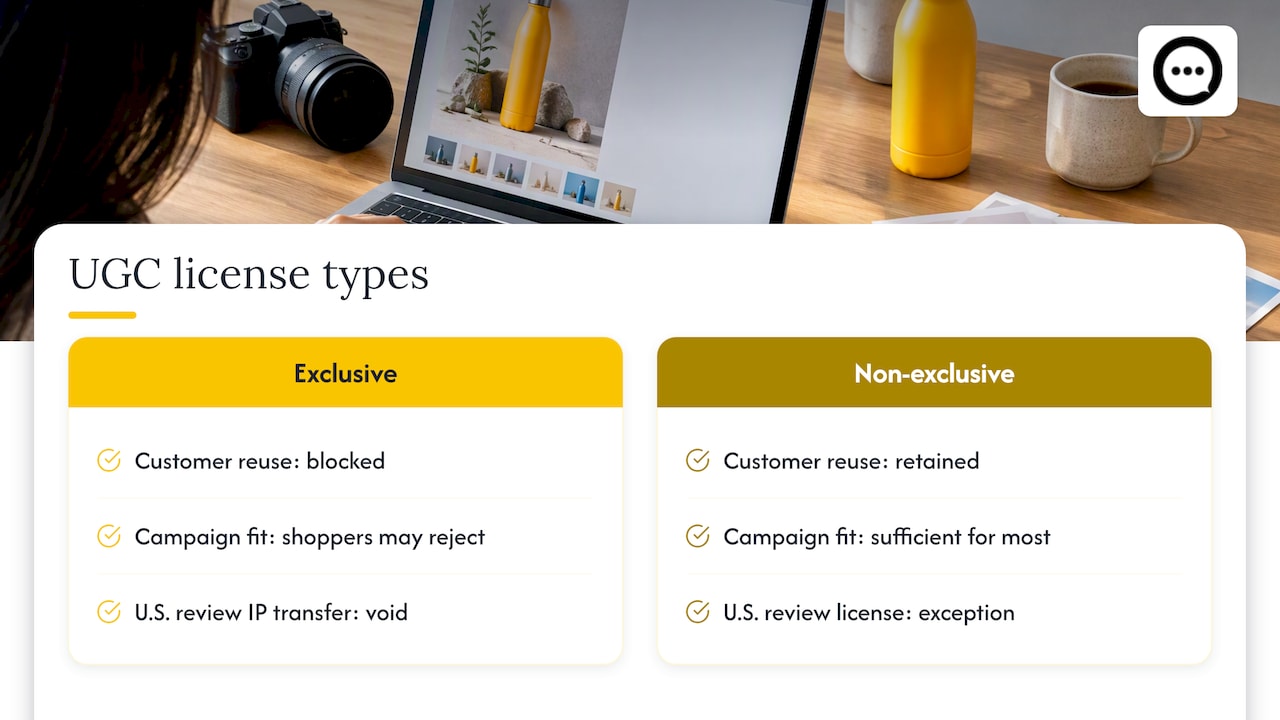
An exclusive license or copyright assignment would stop the customer from using their own work. Most shoppers will not agree to that, and in the US it can backfire. Under 15 U.S.C. § 45b, which was enacted to protect the integrity of consumer reviews, contract terms that force a customer to transfer intellectual property rights in review content are void, except for a non-exclusive license.
The same legal analysis notes that for most UGC campaigns a non-exclusive license is sufficient, and that having it in writing helps you prove its scope later. So the practical rule is simple: ask for the smallest license that does the job, and ask for it clearly.
Avoid burying the grant in your standard terms of sale. Revision Legal recommends dedicated campaign forms or processes instead. A checkbox at the point of upload, with plain wording, is far easier to defend than a clause on page nine of your terms.
What a UGC permission should spell out
A vague “you may use my content” invites disputes. One Australian legal publisher advises an explicit license for customer photos and videos that names the purposes and addresses territory, duration, editing and attribution. The advice comes from Australian law, but the drafting logic carries over to any store. Here is a checklist you can adapt.
| Term | What to decide | Example wording for a form |
|---|---|---|
| Purpose and channels | Product page only, or also email, social and paid ads? | “We may show your video on our product pages and in our marketing.” |
| Duration | Fixed period or until withdrawn | “Until you ask us to remove it.” |
| Territory | Where it may be shown | “Worldwide, wherever our store is visible.” |
| Editing | Trimming, captions, cropping | “We may trim and caption your clip but not change its meaning.” |
| Attribution | First name, handle or anonymous | “Shown with your first name unless you tell us otherwise.” |
| Payment or reward | None, discount, free product | “You will receive a 10% discount code for submitting, whatever your rating.” |
| Withdrawal | How to ask, how fast we act | “Email us and we will remove it promptly.” |
Keep the language short enough that a customer reads it. A license no one understood is a weak license.
Incentives and the FTC: disclose them, never buy praise
If you reward customers for content, the rules tighten. The FTC’s Consumer Reviews and Testimonials Rule took effect on October 21, 2024. The agency treats incentivized reviews as testimonials and prohibits fake, false or materially deceptive reviews. Its guidance says incentives are allowed if they are not conditioned on sentiment, but failing to disclose them could violate the FTC Act.
In practice, that means three habits:
- Offer the same reward whether the review is positive or negative. Never say “leave five stars and get a discount.”
- Disclose the reward next to the content. A short line such as “Reviewer received a free product” works.
- Do not publish only the flattering submissions. Moderate for relevance and abuse, not for sentiment.
The regulation also requires a clear and conspicuous disclosure when you publish a testimonial from an officer, manager, employee or agent whose relationship is not otherwise clear to the audience. Your team’s own videos are fine, but label them.
The FTC has also required brands that use endorsers to monitor those endorsements and disclosures, as in its UrthBox consent order. Treat that as a good model: have someone check what is live on a schedule.
For ready-to-use wording, see our pages on FTC endorsement rules and copy-ready disclosures and how to reward customers for reviews compliantly. If you want to see how review trust also feeds search visibility, this piece on online reviews and ecommerce SEO covers the overlap.
Social posts and tags are not automatic permission
A shopper tagging your brand on Instagram or TikTok feels like an invitation. It is not a license. Platforms grant themselves broad licenses in their own terms, but those licenses are between the user and the platform. The music publishers’ trade group has pointed out that users cannot grant rights to content they do not own. A video with a copyrighted song in the background can carry rights that the poster never had to give you.
The safer routine, echoing the Australian guidance above, is a reply-to-consent workflow:
- Comment or message the creator saying exactly what you plan to do with the content and where.
- Wait for a clear, affirmative answer.
- Save a screenshot with the timestamp and the creator’s handle.
- Do not treat a public post or hashtag as unrestricted commercial permission.
Be extra careful with clips that include trending music, logos of other brands or other people in frame. When in doubt, ask the customer to submit a fresh video through your own form.
When a person appears in the content
Copyright is only one layer. If a customer’s face, name or voice appears, publicity and privacy rules come in. In the US, many states recognize publicity rights that restrict using a person’s identity for advertising without consent. New York, for example, requires written consent to use a living person’s name, portrait, picture, likeness or voice for advertising or trade.
So for video reviews, collect consent that covers appearance as well as the content itself. Check also for minors, family members and bystanders in the shot. Our guide on video privacy checks before customer videos go live walks through four of these checks, and the one on consent for Q&A publishing covers questions and answers from shoppers.
A simple permission workflow for a Shopify store
Here is a routine small teams can run without a lawyer on retainer for every clip.
- Ask at the moment of submission. Put the license request on the upload form, not in a later email.
- Use a separate, unticked checkbox. It should say what you will do in one or two sentences and link to the longer terms.
- Store the evidence. Keep the customer’s name or email, the date, the wording they saw and the content itself.
- Moderate before publishing. Check for personal data such as addresses, order numbers and faces of third parties. Our six-step moderation workflow shows how.
- Disclose rewards beside the content. Use the same label every time.
- Review the live content on a schedule. Remove anything you can no longer support.
If you are still setting up collection, the walkthrough on collecting video reviews from QR code to product page shows one low-friction path.
Handling withdrawals, takedowns and other countries
Permission can be taken back. The Dutch Data Protection Authority says that if a person withdraws consent to publish their personal data on a website, publication is no longer permitted from that moment. That is EU-style data protection, which applies if you sell to shoppers there, and it is a sensible standard to meet everywhere.
Build a removal routine before you need one:
- Publish an email address for removal requests.
- Remove the content first, then investigate.
- Log the date of the request and the date of removal.
- Check where else the content was reused, such as ads, email and social, and pull it there too.
Rules differ by country. A survey of 16 Asia-Pacific jurisdictions found that takedown, privacy, consumer-protection and copyright rules vary, and procedures can involve rights-holder notices, court orders or counter-notifications. If you sell internationally, apply the law of the shopper’s country and get local legal advice for any disputed or high-risk case, such as a claim from a music rights holder or a person who says they never consented.
Our perspective on rights and trust
We built Peers around a simple idea: the content that earns trust is the content shoppers choose to give you, after they have actually bought and used the product. That starting point makes rights easier, not harder.
When a customer records a video review or asks a question through a form on your product page, you know where it came from, when, and what they agreed to. Compare that to scraping tagged posts from social platforms, where you are guessing at ownership and consent after the fact.
We also think moderation is part of the rights conversation. Reviewing what goes live is how you catch personal data, third-party music and undisclosed rewards before they reach a shopper. Peers is designed for Shopify stores with moderation tools so that you decide what is published, and its design customization lets you place the disclosure wherever your theme needs it.
Our advice to every store owner: ask for the narrow license, in plain words, at the moment of upload. Keep the record. Make removal easy. Do those three things and the legal side of UGC becomes routine, which leaves you free to focus on what shoppers want to see.
Leo
Collect consented video reviews and Q&A on Shopify
If you want post-purchase video reviews and shopper Q&A on your product pages without stitching together forms and spreadsheets, Peers on the Shopify App Store was built for that. It is a Shopify-only app with moderation tools, customizable design, mobile compatibility and analytics for engagement tracking. There is a free plan, and the Peers Growth plan is $15 per month.
You still write your own permission wording and keep your own records, as covered above. For setup, our guides on embedding post-purchase video reviews without theme code and publishing video reviews within 1 GB and 10 minutes show what to expect.
FAQ
Do I need a customer’s permission to show their review on my Shopify store?
Yes, as a rule. The customer generally owns the copyright in what they write or record, so you need at least a license to display it. When the review is submitted through your own form, a clear statement at submission, with a record of the customer’s agreement, is the cleanest way to cover it.
Is tagging my brand on social media the same as giving permission?
No. A tag or hashtag does not amount to unrestricted commercial permission. Message the creator, say exactly how you will use the content, wait for a clear yes and save a timestamped screenshot of the reply.
Can I require customers to transfer copyright in their reviews?
Not safely in the US. Under 15 U.S.C. § 45b, terms that force a transfer of intellectual property rights in review content are void, other than a non-exclusive license. Ask for a non-exclusive license instead, which is enough for almost every store use.
Can I give a discount in exchange for a video review?
Yes, if the reward does not depend on the review being positive and you disclose it clearly. The FTC treats incentivized reviews as testimonials and bars fake or deceptive ones. Offer the same reward for any honest review and label it next to the content.
What should I do if a customer asks me to remove their video?
Remove it promptly, including any copies in ads, email and social, and log the request and the removal date. Under EU-style data protection, publication is no longer allowed once consent is withdrawn. Seek local legal advice if the request comes with a legal claim.
Sources
- The Compendium of U.S. Copyright Office Practices, Chapter 1000
- Using Customer Reviews & UGC Legally, Revision Legal
- The Consumer Reviews and Testimonials Rule: Questions and Answers, FTC
- 16 CFR Part 465, Rule on the Use of Consumer Reviews and Testimonials, eCFR
- UrthBox, Inc. consent order analysis, FTC
- User-Generated Content: Legal Considerations, Sprintlaw
- NMPA letter to the U.S. Copyright Office, May 2024
- Publishing and removing personal data on the Internet, Dutch Data Protection Authority
- INTA Intermediary Liability and Takedown Policies in Asia
- Online Reviews: Impact on Ecommerce SEO Success